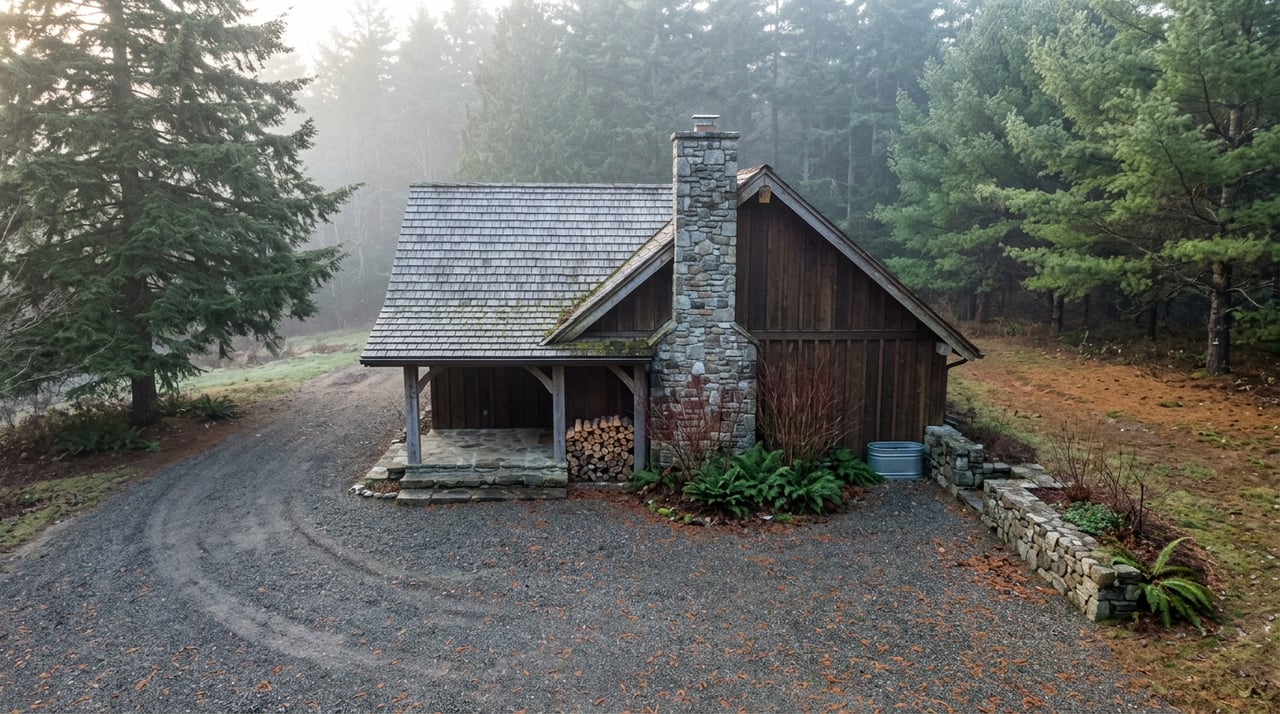
Two homes and more than 42 acres went up for public auction this summer on Cross Fork Creek Road, pond and trout streams included, sold in two tracts or as a whole to the highest bidder rather than at a fixed asking price. That's not an edge case. In a place this small, an auction result can carry as much weight in shaping "the market" as a dozen ordinary closings would somewhere else, and a stat sheet that only reports a median price erases the fact that it happened at all.
Which brings us to the number everyone actually searches for. Cross Fork's median home value sits at $79,500, well under Potter County's $100,000 median and a small fraction of the $308,980 national figure. On its face, that looks like an invitation: buy in, get more house, pay less. But a median built from a handful of transactions a year doesn't behave like a median built from hundreds. Cross Fork has under 200 households total, and the pool of active listings at any given moment has run as low as two or three properties across major listing sites. When your entire sample size is that small, the median isn't tracking a trend. It's reporting whichever specific camps and tracts happened to close most recently, full stop. A single high-dollar acreage sale or a single stripped-down hunting cabin can swing that number by tens of thousands of dollars in either direction.
Acreage Doesn't Price by the Acre Here
If the home-value median is noisy, the land market tells a clearer story, and it's a counterintuitive one. Recent Cross Fork-area land listings show a 114-acre tract on Shepard Road, adjoining thousands of acres of the Susquehannock State Forest, priced at $415,000 after a reduction. Down the road, a 53-acre parcel on Chestnut Street along SR144 listed for $489,900. Smaller tracts show the same pattern in miniature: 2.5 acres on Stewart Hill Road at $132,000, and a 2.632-acre lot on Dip Hollow Lane at $70,000.
Line those up and the logic stops being about size:
| Parcel | Acreage | Price | Notable feature |
|---|---|---|---|
| Dip Hollow Lane | 2.632 acres | $70,000 | Vacant, Clinton County side |
| Stewart Hill Road | 2.5 acres | $132,000 | Improved lot, Clinton County side |
| Chestnut Street (SR144) | 53 acres | $489,900 | Road frontage on state route |
| Shepard Road | 114 acres | $415,000 | Remote, adjoins state forest, price reduced |
The 114-acre tract is more than double the size of the 53-acre one and costs less. That's not a typo. It's what remoteness does to a price tag out here. The Shepard Road parcel backs directly into state forest land, which means privacy and hunting access, but also a longer drive on unpaved roads and none of the frontage that makes a property easy to subdivide, finance conventionally, or resell quickly. The Chestnut Street tract sits along a state route, which buyers and lenders both treat as a meaningfully different asset even at half the acreage. If you're comparing "price per acre" across Cross Fork listings without asking about road frontage and access, you're comparing two different products that happen to share a zip code.
Off-Grid Is the Default, Not the Exception
A lot of what pulls Cross Fork's median down isn't neglect. It's just how camps out here have always been built. Listings in this stretch of Potter County routinely describe holding-tank septic systems, generator power instead of grid electric, and water that's gravity-fed from a natural spring rather than piped from a municipal line. One cabin near Kettle Creek even runs on two outdoor privies with no grid electric at all, a setup that's unremarkable for a camp that's spent decades as a seasonal hunting retreat.
None of that makes a property a bad buy. It does mean a buyer coming from a suburban market needs to ask different questions than the ones a standard home inspection covers. Financing gets more complicated when a lender's checklist assumes a conventional septic system and a utility hookup that doesn't exist. Some of these properties move through cash purchase or seller financing instead of a standard mortgage precisely because the infrastructure doesn't fit a conventional underwriting box. That's a transaction detail worth knowing before you fall in love with a listing photo, not after.
The Trail Season Just Got Bigger
There's a newer variable reshaping demand here, and it has nothing to do with square footage. Pennsylvania's Northcentral Regional ATV Trail expanded for the 2026 season, adding roughly 380 miles of connected roads and 94 miles of preferred route, mostly in Tioga County, which brings the total designated network to nearly 1,000 miles across Clinton, Lycoming, Potter, and Tioga counties. The 2026 season runs from late May through the end of September, and for the first time the trail system carries a formal, address-based permit fee: $70 for Pennsylvania residents, $100 for nonresidents.
Part of that expansion runs right through this corner of Potter County. A stretch of Route 144 near Button Hollow Road was approved this year for inclusion in the network, adding a 2.75-mile legal connection into town. That matters because Susquehannock State Forest's original 43-mile ATV trail, the one riders have used for years out of the district office and trailheads like Lyman Run, is now formally stitched into a much larger regional system rather than functioning as an isolated loop.
For a buyer weighing a camp or small acreage tract here, this is the piece a national housing stat will never surface. As permitted, legal trail mileage grows and informal riding gets replaced by a fee-based system with defined access points, proximity to a legitimate trailhead becomes its own pricing lever, separate from acreage, separate from square footage. A three-acre lot with a documented driveway onto the network may end up worth more to the right buyer than a much larger parcel with no legal connection at all.
What This Means If You're Actually Comparing Towns
If you're cross-shopping Cross Fork against another Potter or Tioga County community, the median price alone won't tell you much. Ask instead about road frontage, septic type, power source, and whether the parcel connects to a legal, permitted trail or road system. Expect some of the best acreage here to move through auction or word of mouth rather than a standard 60-day MLS listing, which means timing and being ready to act matter more than they would in a market with steady weekly inventory. Mountain Valley Realty has represented Potter County acreage listings that fit this exact profile, cleared building sites with year-round stream frontage and mixed open and wooded ground, and that hands-on familiarity with what these tracts actually need before closing is the difference between a smooth transaction and a surprised one.
Cross Fork isn't cheap in the way a headline number suggests, and it isn't complicated in a way that should scare off a serious buyer either. It's a market where the price reflects road access, infrastructure, and now trail connectivity more than it reflects anything a standard comp sheet was built to capture.
FAQ
Is Cross Fork's median home price a reliable way to estimate what I'd pay? Not on its own. With so few active listings at any time, the median reflects whichever specific properties recently closed rather than a broad market trend. Use it as a starting point, not a budget.
Do most Cross Fork properties have full grid electric and municipal water? Many camps and smaller cabins run on generator power, well or spring water, and holding-tank septic systems. This is standard for the area rather than a defect, but it changes what financing and inspection look like.
Does ATV trail access affect resale value here? It's becoming a more visible factor as the regional trail network formalizes permitting and adds new legal connections, including a stretch of Route 144 approved this year in this corner of Potter County.
Thinking about a camp, acreage tract, or year-round home in Cross Fork? Mountain Valley Realty knows this ground, the access roads, and what actually changes hands out here. Call now to talk to a local agent before your next trip up Route 144.
This article is general information, not legal, tax or financial advice. Consult a qualified professional about your situation.